The Boundary Line Hiding Under the Braddock Road Metro Platform
Stand at the corner of Wythe and West Streets in Rosemont and you are standing in two neighborhoods at once, though only one of them has a name on a map anymore. Tomorrow, September 13, marks one year since the Commonwealth of Virginia planted a state historic marker on that corner, directly across from the Braddock Road Metro entrance most Rosemont residents pass through without a second glance. The marker does not commemorate something that happened somewhere else. It commemorates something that happened right there, on the ground under the platform.
Here is the fact that reframes the whole corner: the line that once separated white Rosemont from the neighborhood people called Colored Rosemont runs through what is now the Braddock Road Metro station itself. Audrey Davis, who directs the Office of Historic Alexandria's African American History Division and has spent years researching this history, has said as much directly: the two communities were divided by the ground the station now occupies. Every commuter who taps a SmarTrip card at Braddock Road is standing on a border that used to mean something entirely different than a train platform.
The story does not start with the marker. It starts in 1926, when a real estate broker named Virginia F. Thomas began selling individual lots to African American families on land bounded by Pendleton, Fayette, Madison, and N. West Streets. That boundary sits on the eastern edge of today's Rosemont, near where the Rosemont Citizens Association draws its own modern lines along King Street, Mount Vernon Avenue, and the Alexandria Avenues.
What makes Thomas's role unusual is where she herself lived. She had bought a house at 16 W. Rosemont Avenue in 1912 and married there in 1919, meaning she was a resident of the white Rosemont neighborhood while she was subdividing and selling land next door without the restrictive covenants that were standard practice at the time. Those covenants existed specifically to keep Black families out of neighborhoods like her own. Thomas sold to them anyway, to both extended families and individual couples, and the majority of her buyers were working people building something for the first time.
By 1939, the block Thomas had subdivided was fully built. Families with names like Berry, Burke, Churchill, Dundas, Jackson, Johnson, Hickman, McCray, Morrison, and Watson put down roots there, and by around 1950 the area had grown into a settled community of Black middle-class households living between Madison, Pendleton, N. Fayette, and N. West Streets. Because the name "Colored Rosemont" was used informally rather than printed on official plats, the neighborhood is largely absent from the historic maps that survive from the period, even though it was every bit as real as the Rosemont next door.
The neighborhood did not fade through market forces or the slow churn of a changing city. In the 1960s, the City of Alexandria used eminent domain to acquire property throughout Colored Rosemont, paid the owners, and built a public housing development in its place. This happened over a formal legal challenge. A Black attorney named Otto Tucker argued the city had selected the site because its residents were Black, and the Alexandria Redevelopment and Housing Authority dismissed the argument as irrelevant to the proceedings. The homes came down anyway.
That history is why Mayor Alyia Gaskins framed the marker dedication the way she did, tying the neighborhood's displacement directly to the city's current housing conversations. She spoke about a council that had heard from public housing residents about ongoing inequities that same morning, and connected that to a future she described as one where homeownership becomes a reality for more families in the city, not just a possibility.
Only one original structure from Colored Rosemont survives: the house at 1312 Wythe Street. The marker itself borrows its language directly from that address, reading in part that it is the only original dwelling from the once-thriving, predominantly African American neighborhood known as Colored Rosemont, and naming the children born there, James "Butch" Nelson, Robert Thomas Greene Jr., Veronica Greene-Pace, Stanley Russell Greene I, and John Oswald Greene I. Stanley Greene, one of those children, spent years pushing for this recognition. Audrey Davis credited his advocacy directly, saying none of the marker's existence would have been possible without his persistence and the work of the Colored Rosemont Descendant Advisory Group, which the Office of Historic Alexandria began collaborating with in 2022.
At the dedication, Krystyn Moon, a historian at the University of Mary Washington who served as project historian for the effort, spoke about the neighborhood's central place in Alexandria's larger story. Descendants including Veronica Greene Pace, Sheila Cross Reid, and Deborah Turner shared personal memories from the ceremony, describing everything from the generational wealth homeownership there made possible to the daily texture of life on those blocks before the 1960s.
If you want to experience this history rather than just read about it, here is what exists today within a short walk of the King Street and Braddock Road Metro stations:
None of this requires a special occasion. The marker is outdoors and permanent. The museum keeps regular weekend hours. The archive is public.
Audrey Davis described the ongoing oral history work as community history at its best, meaning descendants are guiding the interpretation rather than having one imposed on them. That distinction matters for anyone living in Rosemont today, because it means this is not a closed chapter with a plaque bolted on top. City staff have said the dedication is only the beginning, with more research and public history work planned. The neighborhood you walk through to catch a train has more layers than the tree canopy and the craftsman bungalows suggest, and one of those layers is still actively being written by the people who lived it.
If you have lived in Rosemont for any length of time and this is the first you are hearing of Colored Rosemont, you are not alone. That is exactly the gap the marker was built to close.
Questions about Rosemont, its history, or what's happening in the neighborhood right now are always welcome. Christina Berkowitz has spent her career rooted in this part of Alexandria and is glad to talk through anything you're curious about. Let's Connect.
Nina is chosen for her strategic approach, strong negotiation skills, and ability to navigate complex transactions with clarity and confidence. Her corporate sales background gives her an edge in pricing strategy, contract execution, and client advocacy. She serves Fort Hunt and surrounding Northern Virginia, delivering stronger outcomes at every stage of the process.
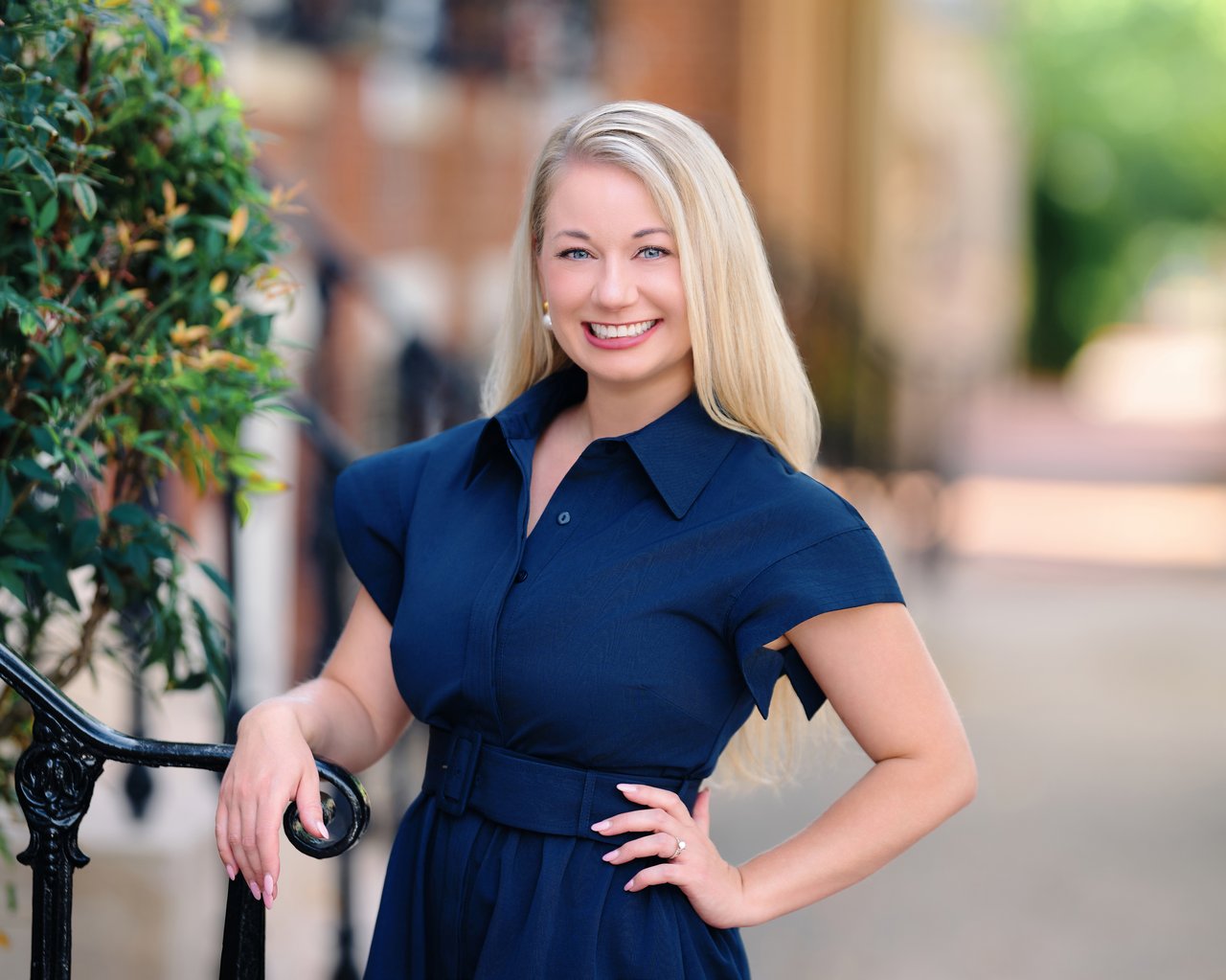
Christina "Nina" Berkowitz
109 S PITT ST ALEXANDRIA, VA 22314