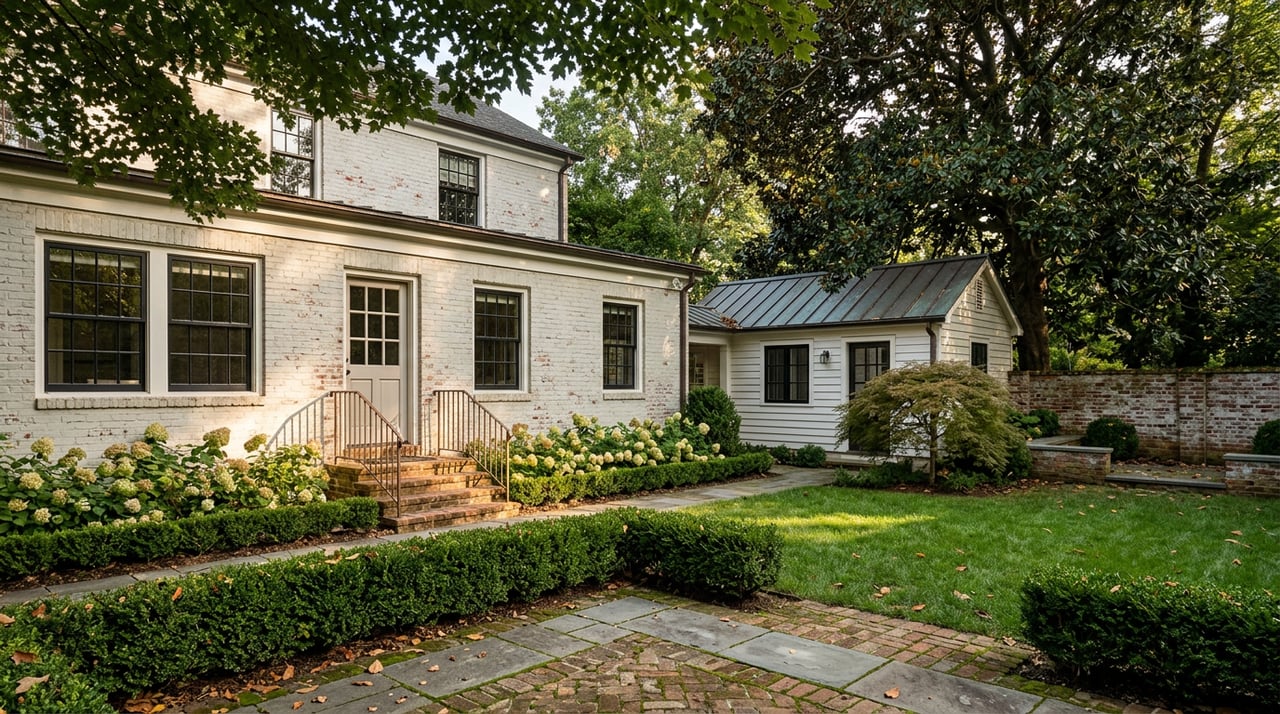
Why Del Ray Homeowners Are Adding Cottages Instead of Kitchens
A few years back, a Del Ray homeowner ran into a wall over something as small as a wall oven. Renovating a rear kitchen, the family assumed a straightforward remodel. City staff disagreed. Under the zoning code at the time, adding almost any cooking appliance without an existing cooktop could trigger a full ADU review, since the ordinance treated the mere possibility of independent cooking as evidence of a second dwelling unit. The confusion added months to the project and forced the family to hire a design-build firm with specific ADU experience just to get a routine renovation across the finish line.
That story is a useful marker of how far Del Ray's rules have moved since. The same decision that once cost a family months of delay is now the deliberate, encouraged path for a growing number of neighbors who are choosing to build a small second home in the backyard rather than gut the one they already own.
The confusion in that kitchen story sat inside an older, patchwork zoning code that treated accessory living space as a special exception rather than an ordinary choice. The City has since rewritten the underlying framework. Alexandria's Zoning for Housing initiative, adopted by City Council in November 2023, reviewed decades of case-by-case approvals for small residential infill and found that nearly every one of the requests studied over a seven-year period had ultimately been approved anyway. The City's own conclusion was that special approval for these projects should not be required at all, and that contextual infill, including accessory dwelling units, should be allowed by right instead.
In practice, that means an ADU in Del Ray today goes through administrative zoning and building permit review, not a public hearing. There is no case-by-case debate in front of a board. The rules are written down, and a homeowner who meets them gets a permit.
If the zoning rewrite made ADUs legal in practice, the Del Ray House & Garden Tour made them visible. The Del Ray Citizens Association, a neighborhood nonprofit founded in 1954, has hosted the self-guided tour every other year since 1999, always on the Saturday of Mother's Day weekend. The 2026 edition ran May 9 and featured a dozen properties, the largest tour map in the event's history, including two accessory dwelling units for the first time.
One was a garage that had stood for 28 years before being converted into a guest house about three years ago. Another paired a 1920s bungalow with a grandparents' cottage tucked into the back yard, the kind of arrangement families increasingly use for aging parents, adult children, or rental income rather than gutting the main house to make room. Tour proceeds, which topped $30,000, went toward the Scholarship Fund of Alexandria, after-school tutoring at Mount Vernon Community School, and restoration of the neighborhood's Little Red Caboose, which opened to tour visitors for the first time in over a decade.
"The eclectic nature of our neighborhood is what makes it great."
That line came from Lisa Quandt, who chaired this year's tour committee. It doubles as a fair description of what Del Ray's housing stock is becoming: not uniformly renovated bungalows, but a mix of original footprints, additions, and small backyard structures that let a family grow in place without erasing what made the block distinctive to begin with.
None of this happens in a vacuum. Del Ray remains one of Alexandria's tighter markets. Single-family homes there generally priced from the mid-$800,000s to just over $900,000 through the first half of 2026, with the median across every home type in the neighborhood reaching $945,000 in March 2026. That price ceiling matters more than it sounds, because it sets a hard limit on what any single renovation can return.
A Northern Virginia general contractor's 2026 remodeling guide put the caution plainly: a $400,000 kitchen inside a $900,000 Del Ray bungalow is usually a resale mistake, however much a family enjoys living with it. The lifestyle value can be real. The resale value rarely follows, because the house is still capped by what the block will bear.
An ADU changes the comparison. Detached units in Alexandria typically run somewhere between $120,000 and $320,000 depending on whether the project is a garage conversion or new construction, well under the cost of a top-end interior remodel, and the square footage it adds does not compete against the same per-square-foot ceiling that governs the main house. It is a separate structure with its own economics, which is part of why families weighing "spend big inside" against "add space outside" increasingly land on the second option.
| Approach | Typical Cost Range | What It Actually Buys You |
|---|---|---|
| High-end kitchen remodel | $175,000 to $400,000+ | Better living day to day, limited resale lift once you exceed the block's ceiling |
| Garage conversion ADU | Roughly $120,000 to $190,000 | Independent living space, rental or multigenerational flexibility |
| New detached ADU | Roughly $160,000 to $320,000 | A second structure with its own kitchen, bath, and entrance |
The specifics matter because they determine whether a given lot actually qualifies. Alexandria's ADU program sets the maximum size at whichever is greater: one-third of the main house's floor area, or 350 square feet on lots up to 2,500 square feet, rising to 500 square feet on larger parcels. Setbacks run as small as one foot from the rear property line, three feet if the unit has windows facing that line, and the City does not require additional off-street parking for the new unit. Owner-occupancy is confirmed at the time the permit is issued, with no ongoing requirement afterward, and typical administrative review runs 70 to 100 days.
One detail is easy to miss and worth knowing if you're comparing Del Ray to other close-in neighborhoods. Alexandria recognizes only two locally regulated historic districts, Parker-Gray and the Old and Historic Alexandria District, which covers Old Town. Del Ray sits outside both. That means an ADU or addition here moves through standard zoning and building review rather than the Board of Architectural Review calendar that governs exterior projects in Old Town, a genuinely different timeline than a seller or renovator would face a mile away.
Virginia lawmakers passed a broader statewide ADU mandate this spring that will require every locality to allow accessory units by right, with a compliance deadline in mid-2027. Alexandria's own ordinance predates that law, and localities with an existing ADU program in place are not automatically required to adopt the new statewide rules. For now, the City's current framework, the one described above, is what actually governs a Del Ray project. Anyone planning further out should expect Alexandria's specific numbers, not the state's, to be the operative ones until that changes.
Does the ADU have to stay a family arrangement, or can it be rented out? Alexandria's owner-occupancy requirement applies to the primary home at the time of permitting, not to who lives in the ADU itself, which is part of why the unit type works for both multigenerational households and straightforward rental income.
Will adding an ADU raise my property tax bill? A permitted ADU adds to your home's assessed value, which typically increases the property tax assessment, since the City is now valuing two structures instead of one.
Do I need Board of Architectural Review approval for an ADU in Del Ray? Not for standard cases. Because Del Ray falls outside Alexandria's two locally regulated historic districts, ADU projects here go through administrative zoning and building review rather than BAR's certificate of appropriateness process.
If you're weighing whether to renovate in place, add a cottage, or sell and move up somewhere else in Del Ray or a neighboring pocket of Alexandria, the math looks different for every lot and every budget. Christina "Nina" Berkowitz has spent years walking Del Ray clients through exactly this kind of decision, from what a specific block will actually support at resale to how a project timeline fits around a family's real life. Let's Connect if you want a clear-eyed read on your own situation before you spend a dollar on either option.
Nina is chosen for her strategic approach, strong negotiation skills, and ability to navigate complex transactions with clarity and confidence. Her corporate sales background gives her an edge in pricing strategy, contract execution, and client advocacy. She serves Fort Hunt and surrounding Northern Virginia, delivering stronger outcomes at every stage of the process.

Christina "Nina" Berkowitz
109 S PITT ST ALEXANDRIA, VA 22314